

Your Support Worker CV must show your ability to help people carry out their daily tasks, teach them new skills and provide emotional support.
In it you have to stress your knowledge of relationship building, administering medication, maintaining records and relationship building. All of this information has to be presented in a concise and easy-to-read format that is broken down through descriptive headings for your personal summary, work experience, skills, and education sections.
A CV at its core is a brief snapshot of your most relevant skills, achievements, and work experience to date. However, because since employers often spend just a few seconds scanning it, it has to written in a way that immediately grabs their attention.
Writing up one can feel daunting, but it doesn’t have to be. That’s where this page can help, keep reading to write one up that gets you noticed by recruiters for all the right reasons.
By: Iejaz Uddin – Updated 4 December 2025
Page overview
- Support Worker CV examples
- How to write a Support Worker CV
- CV structure
- Contact details
- Personal summary
- Support Worker work experience
- Skills
- Education section
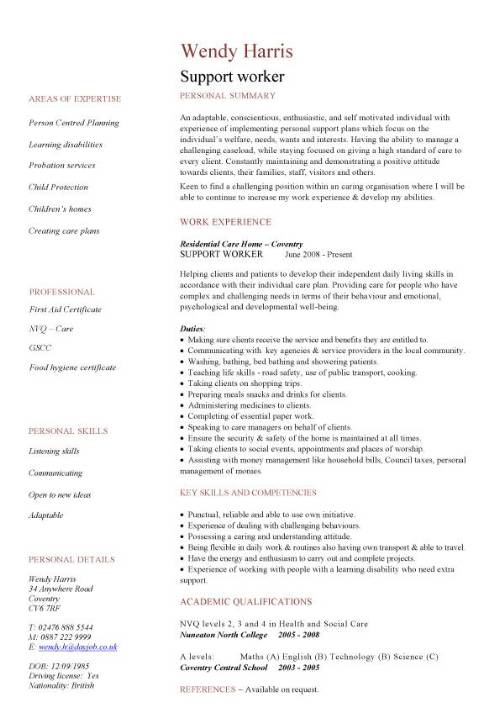
Support Worker CV sample
Sign Up
Get immediate access to over 1000 + Premium CV templates.
All for ONLY $4 a month.
100’s stunning designs that will make you STAND OUT and highlight your Skills and Expertise.
With all our Premium templates you will get the fully editable MS Word;
- One page version.
- Two page version.
- Matching cover letter.
All you need to do is simply enter your personal details into the ready made text boxes and within minutes you will have a professional CV.
Unlimited downloads – Money back guarantee – Cancel anytime.
How to write a Support Worker CV
In the UK a CV is the most common way of applying for a job.
You’ve got to submit one that shows you’re the best qualified candidate for the position through your past work experience, skills and future potential.
As a Support Worker is responsible for supporting people to make positive changes in their lives you’ve got to show you are a proactive individual who is not afraid to roll up their sleeves. Give examples of how you have supported people with a diverse range of complex needs, including learning disabilities, autism, physical disabilities and mental health needs.
Many jobseekers really struggle on writing one and on condensing their life into a two-page document. It can be challenging trying to summarize years of education, work experience, and achievements concisely without leaving out important details. Remove the guesswork from creating your CV by following the tips on this page and using our ready-made examples as a guide.
Support Worker CV Structure
The layout of your CV refers to its structure and how information is arranged on the page to make it visually appealing and easy to read.
A good CV design is all about clarity, readability, and making a strong first impression on the reader. This is best done by using plenty of white space to avoid a cluttered look, keeping margins consistent and using clear headings for the Personal Summary, Work Experience, Skills and Education sections.
A good structure is not just about looking good, it’s about making it easy for prospective employers to quickly find the information they’re looking for.
Contact details
Recruiters need to contact you, and this is where they do it.
On a CV, your contact details should be clear, professional, and easy for employers to find. Place your full name, email address, phone number, and location prominently at the top of the page. Double check the spelling here, as a simple typo can make you uncontactable. In rare cases, you may also be asked to include a photo on your CV, is so insert this as well.
As its one of the first things a recruiter sees, it should be written in a professional font and larger than average bold text. This will also make a confident statement about who you are.
Support Worker CV Personal Summary
Your personal summary is a short, introductory section at the beginning of your CV that highlights your strongest points. Think of it as a brief conversation with the recruiter that answers the questions they may have about you.
Explain what you’ve done in the past, what you’re doing now, and what you hope to achieve in the future. It can range from a short phrase to a few sentences that serve as an opening statement which captures your professional journey and emphasizes your most relevant skills.
For a Support Worker position that means things like helping people use the bathroom, take their medication, shave, bath and dress. Use it to show your expertise and how you can be an asset to the company and the role you’re applying for.
Work Experience section
It’s here that you talk about the practical skills and knowledge you’ve built up through both paid and unpaid roles.
Use this section to connect your past responsibilities to the requirements in the job description. This will help recruiters quickly see that you have the real world experience needed to succeed in the role. You can also use it to highlight the times you’ve overcome challenges, resolved conflicts and achieved goals.
For a Support Worker position that means coming across as a caring and compassionate individual who is able to build positive relationships with others. Through your work experience demonstrate how you have in the past helped people to manage their budgets, pay bills, do their housework, organise appointments and cook delicious healthy meals.
Start by listing your previous jobs in reverse chronological order, starting with your most recent one and working backwards. Include key details like the company name, your job title, location, and your employment dates.
When describing your past duties or achievements, start each sentence with a strong action verb, and use numbers or metrics to make your contributions concrete and memorable.
Support Worker CV Skills
Showing you possess the right skills can put distance between you and other applicants.
To be a Support Worker you need to be able to show you are compassionate as well as skilled can create a positive, structured, and empowering environment for those vulnerable people you look after. You can go even deeper by identifying the skills that employers want, then if you have them include them in your CV.
Use the STAR method (Situation, Task, Action, Result) to share these and give clear examples of how you’ve used them to achieve real results. Present them in bullet points, using a maximum of five to keep things focused and easy to read.
Support Worker skills to list in your CV
Education
At the end of your CV is your education section where you list your academic history.
This is where you give recruiters a snapshot of your educational journey by listing the qualifications, training, and certifications you’ve earned. For each entry, mention the name of the qualification, the institution, its location, the dates you attended, and any grades or results achieved.
Even though this section often appears at the bottom of your CV, a strong education record can show recruiters more than just your grades. It can reflect your study habits, critical thinking, research skills, communication abilities, and any practical or technical skills you’ve developed. Done properly it can reassure employers that you have the mindset they’re looking for.
Support Worker cover letter example
Social worker CV example
Social Worker cover letter examples
Social worker cover letter example
Social Services Coordinator CV templates
Social Services Coordinator CV template 1
Outreach Worker templates
Outreach Worker cover letters
Outreach Worker cover letter example
Counsellor CV
Online Social Work degrees
Campus Social Work degrees