

An ideal CV should be no longer than 1 to 2 pages. It must be as short as possible because recruiters will spend only a few seconds scanning it and do not have the time to go over long documents. In a concise CV employers can quickly spot your strongest skills, achievements and work experience.
The key to getting the size right is quality over quantity. Therefore, ruthlessly exclude old, repetitive, or irrelevant information that takes up valuable space and adds no value to your job application. Here are some general guidelines for how long a CV should be:
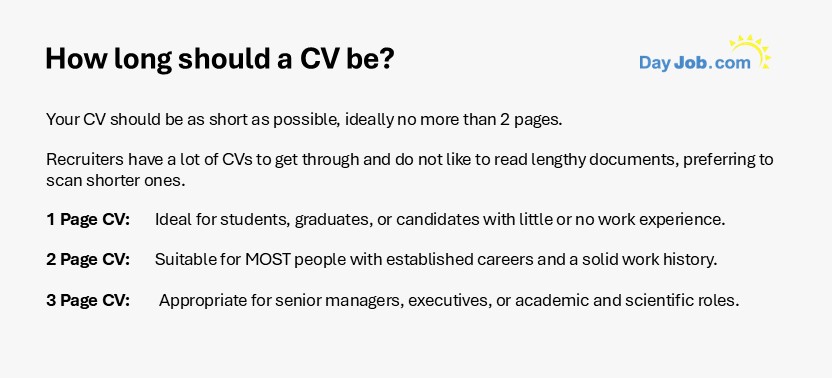
- 1 Page CV: Suitable for candidates with little or no work experience such as students or graduates.
- 2 Page CV: Ideal for Professionals with established careers and a solid 4 year plus work history.
- 3 Page CV: Appropriate for those with extensive project portfolios such as senior managers, executives, or academic, researchers and scientific roles.
By: Iejaz Uddin – Updated: 7 August 2026
Page overview:
- How long should your CV be
- What’s the best length for a CV?
- One page CV
- One and half page CV
- Two page CV
- Three page CV
- Why should a CV be short?
- How to shorten your CV
How long should your CV be?
As short as possible is the answer. The reason being that recruiters have a lot of CVs to get through, so they need to quickly get an idea of who you are and your experience. If your CV is too long to scan quickly, you reduce your chances of them finding your strongest skills.
Employers don’t want your autobiography, they want a brief summary of your most relevant key skills and experience. That’s why a long CV can do you more harm than good. Although its tempting to write everything, presenting too much information can significantly decrease your chances of being offered an interview. That being said there are no set limits or rules as to how long it should be and there are some exemptions to the ‘2 page rule’.
Are shorter CVs better?
In a word, yes. Recruiters have a lot of CVs to get through, they want to quickly get an idea of who you are and your experience. They do this by scanning a CV for as as little as a few seconds. If your CV is too long to skim, you reduce your chances accordingly.
Employers do not want a list of everything you’ve done in your career. The last thing they want to see is a long CV jam packed with text from top to bottom, and by being trigger happy with your information, this is exactly what you will give them. Instead Hiring Managers (who have notoriously short attention spans) just want an easy to read document that they can quickly flick through. A short CV will convey your strongest points in a clear, accessible way.

What’s the best length for a CV?
One size doesn’t fit all. Trying to get the delicate balancing act of not overdoing it and not underdoing it is difficult.
Too short, and it can indicate a lack of relevant skills and work experience, whereas too long and it can appear rambling, cluttered and over the top. Below are the main CV sizes available to you and clear advice on selecting the most suitable option for yourself.
One page CV
By condensing your CV to a single-page presentation you can get straight to the point and focus everything into one spot. This you will present yourself as someone who can efficiently communicate with a minimum amount of words.
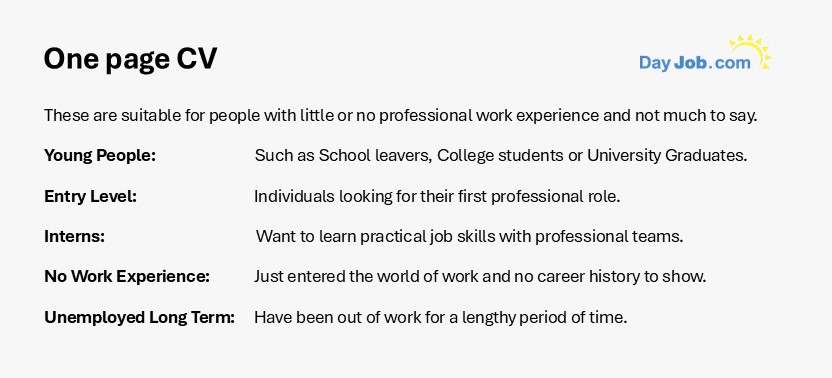
One pagers are ideal for candidates with little or no professional experience, as they still have ample space to highlight your education, skills and internships or volunteer work. You should note though that some employers, agencies and head-hunters may ask candidates to send in a one-page CV.
Ideal for:
- Young people
- School leavers
- College students
Suitable for job seekers who have:
- Only had one role in their career.
- Had very similar jobs in their working life.
- Just entered the world of work and no history to show.
- Been unemployed for a long period of time.
- Applied for Entry Level vacancies.
Advantages
- No need to write an artificially inflated 2 page CV if you don’t have much to say.
Disadvantages
- A one-page CV can been seen as worth less than a two-pager.
- Recruiter may think you don’t have enough to say about yourself.
- Can be difficult to include all of your skills, experience and potential.
One and half page CV – Avoid these
Do not write a one and a half page CV. They look incomplete, give off the wrong vibe and make it seem like you’ve got nothing to say. It’s much better to have a full 1 or 2 page CV.
Suitable for:
- Nobody.
Two page CV
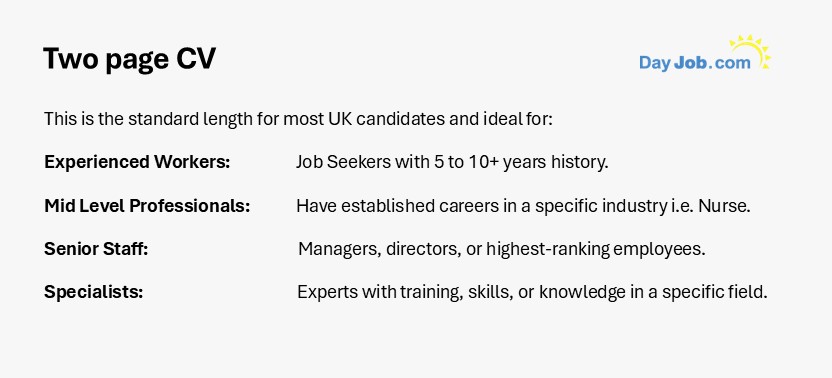
This layout is ideal or most candidates with established careers. It’s also the generally held view in the recruitment world that a standard CV should be no longer than two sides of A4. It provides enough space to demonstrate your relevant skills and room to list specific examples of your abilities, something recruiters want to see. All without the risk of boring the reader with additional pages.
When laying out these make sure its doesn’t look too empty or a bit threadbare, which can happen if you have too much white space in it.
The first page is the the most important one as its read first and where the hiring manager will spend the majority of their time. It should include your most critical and recent information and has to be well written enough to hold the recruiter’s attention. The second page is where you list any supporting information and give a more in-depth account of you background.
Always number your pages (i.e., Page 1 of 2) so recruiters know a second page exists.
Suitable for:
- Most candidates.
- This is the most widely used CV length for job seekers with established careers.
Three page CV
There are always exceptions to rules, and a 3 page plus CV is one of them. Although not as often used as the others previously mentioned, these longer documents are suitable for candidates who are applying for specialist roles and who need the extra space to demonstrate their suitability.
It should only be that long if you have significant work experience, qualifications, or professional achievements that are relevant to the role. Organize your information strategically to maximize readability and present your story in a clear and readable format. The goal is to use extra pages to fully showcase what you can bring to their operations by using the extra space to ell them everything without missing anything.
Three page CVs are ideal for roles where employers have asked for detailed evidence of a candidate’s competencies. Something that can only be done through supplementary pages. They are typically created when applying for academic, medical, scientific, creative and senior roles.
Suitable for:
- Medical professionals
- Academics
- Freelancers
- Contractors
- Directorship-level candidates
- Senior Managers
Ideal for job seekers who have:
- accreditations
- achievements
- assignments
- lengthy bibliographies
- long work histories
- professional qualifications
- published works
- projects
Why should a CV be short?
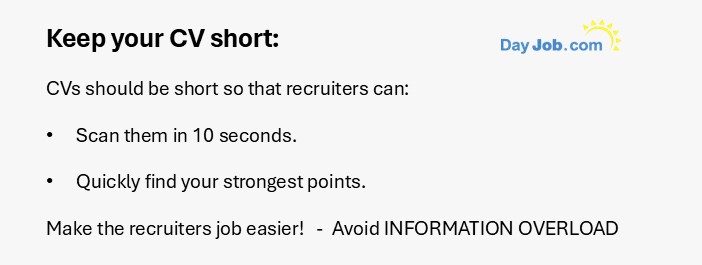
Repeated surveys have consistently shown that when recruiters first view your CV they only spend a very small amount of time looking at it. They can scan it and decide on it in as little as 10 seconds. Meaning that first impressions count, and an overly long CV can be naturally discouraging.
The last thing you want is for your application to be immediately binned because of the way it looks.
Advantages of a short CV
Avoids information overload
- You don’t overwhelm the Hiring Manager with reams of data.
Make the recruiters job easier
- With less content to shift through you can make the employers job more smoother. Something they will appreciate.
Disadvantages of a long CV
Shortage of time
- Recruiters and Human Resource staff are always pushed for time, meaning they have to decide very quickly if a candidate is worth considering.
Recruiter’s workload
- Hiring Managers have to typically shift through 100’s of job applications every day. They simply don’t have time to read anything too lengthy and that looks like hard work.
Key skills get buried
- You run the risk of losing relevant key skills in all that text.
Can’t be evaluated quickly
- With so much going on it’ll be difficult for the reader to assess and find what they’re looking for, leading to them possibly feeling frustrated and giving up.
Reader loses interest
- Some people have short attention spans and can be put and quickly lose concentration in lengthy articles.
It bores the reader
- HR staff are human and can get put off by documents that looks boringly long.
How to shorten your CV
There are a number of ways to cut down the size of your CV. The most obvious one is to avoid too much context, excessive detail or unfocused material, and making sure that every word in you write relates to the role. Others include, avoiding unnecessary personal information like your age, height, marital status and religion. You can also discard photographs, references (a simple “References available on request” will do), reasons for leaving jobs and hobbies.
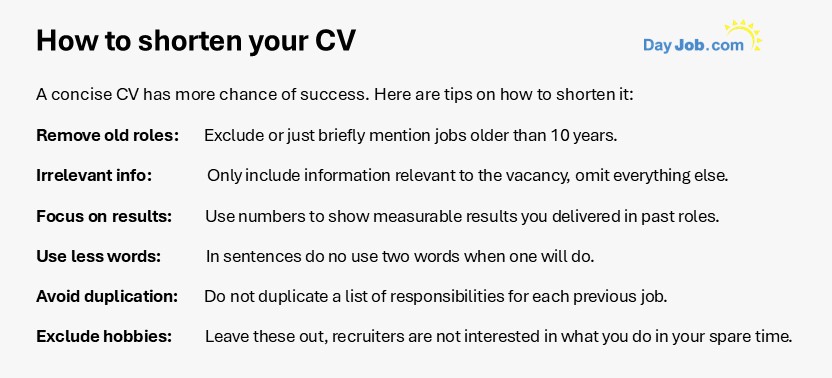
Many job applicants make the mistake of trying to include every key skill, experience, responsibility and qualification they’ve got in order to prove what they can do and impress a prospective employer. The problem is the limited amount of space to do this in, therefore keep it focused on what you were responsible for and what you achieved.
Related: How to shorten your CV
Tips on writing a short CV
Below are tips on how to make more room in your CV by cutting out the waffle from it.
Write your first CV draft
Begin by writing the first draft of your CV. Include everything that you feel is relevant to the job you’re applying for. At this stage of the process don’t worry about its length. You now have something to work on.
Now start editing your CV
Use the below tips to tweak and condense it until you’ve reduced it to the size you want without losing any of your key content.
Brevity
It’s vital you find ways to communicate the same points more concisely. Your aim should be to make every word a sentence and every sentence a paragraph. One way to do this is by continuously re-write what you’ve penned until it only includes the main facts of what you want to convey.
For example;
Original long sentence:
- ‘At work I was chosen to lead a team of five fellow co-workers and supervise them for a specific project which lasted for over six months.’
Shorter version;
- ‘Managed a project team of five, for a specialist program lasting six months.’
To write shorter sentences;
- Get straight to the point.
- Never use two words when one will do.
- Ruthlessly eliminate all unnecessary words and phrases.
Ask yourself, is it relevant?
Always ask yourself if what you are including is relevant to the position you want. If it doesn’t sell you, delete it.
By culling your CV this way, you will also;
- Remove irrelevant information which may detract from other key things about you.
Also exclude:
- Obsolete information that has no direct bearing on the vacancy.
- Skills, qualifications and work experience more than 10 years old. If however, you want to include them then only briefly summarise them.
Avoid duplication
Make sure you do not say the same thing twice. It can be tempting to highlight a particular attribute you have by repeatedly mentioning it in your CV, either word for word or in different ways.
For instance, if in the past you have had different jobs where the duties were very similar, then do not echo the same duties under every role. Doing this can irritate the reader and adds nothing to your application.
Minimize your contact details
Another way candidates waste space is by including far too many personal contact details. Employers do not need to see your full address etc at the initial stage of a job application. All you need to give them is your;
- name
- phone number
- email address
- location (just town or city name)
Personal profile
Cut down your CV’s personal profile to a few sentences, by rewording it until its short, sweet and to the point. Remember, its aim is to give the reader a quick idea of why you are the best person for the job. Nothing more than that. Therefore, remain focused on its key stages of;
- Who you are.
- What you can do for the company.
- Your career goals.
Work Experience
Prospective employers are more interested in the skills that you have obtained recently, rather than what you did 15 years ago. This gives you an opportunity to save some room on your CV.
Trim your employment history to the bare minimum by focusing on your recent and most relevant experience and achievements. Do this by;
- Briefly summarising or even excluding your work experience if it’s more than 10 years old.
- For each of your past positions only give the job title, dates you worked and a one-line description of what you did.
- Not including minor and irrelevant jobs you did when you were a teenager, like paper rounds etc.
What else to leave out of your CV to shorten it
The Title – There is no need to headline your document as ‘Curriculum Vitae’ or ‘CV’, as everyone knows what it is. Instead let your name serve as the title. Also ignore, irrelevant personal information such as your;
- Headshots or other photos
- date of birth
- nationality
- marital status
- religious beliefs
- height
- weight
- Social media accounts on Twitter, Instagram, Snapchat and Facebook for personal use.
There’s also no reason to give details of your;
- Reasons for leaving previous positions.
- Salary from previous employers.
Education
Like with your career section, just focus on your recent and most relevant academic qualifications. Do not include;
- High school exam grades
- High school subjects
- Degree modules
Only include those qualifications, training and certifications which you feel can help your case.
Hobbies and interests
Omit these unless they are highly relevant to the vacancy in question. Remember, activities like ‘socialising with friends’, ‘going to the cinema’ and ‘reading’ are not going to make you stand out.
Related: Hobbies and Interests on a CV
Clichés
Leave out tired old lines like ‘Works well in a team or individually’.
White space
Remember to not go over the top with your space saving. One way to do this is to use a reasonable amount of white space to break up the text, as this can help the Hiring Manager to clearly read your CV.
Font size
Although it may seem insignificant, the size of your font can have an impact on your CV. Too small and it will make the text look crammed and unreadable. Too big and it could appear tacky. If you’re having trouble fitting everything onto a page then consider using a still easily readable smaller font size of 10.5 or 11pt. Whatever you chose, ensure it remains consistent throughout your CV.
Finally, after making any changes always check the writing to ensure it’s not too small to read.
Headings
Use bold and larger sizes of say 14 points for all headings as these help to create a font hierarchy across the document.
Line breaks
Only use a single line break between each heading and the body of the text below.
Margins
Consider reducing the margins. But, be careful not to make them too thin, otherwise your CV could look too big.
To adjust your margins in Microsoft Word, simply click Layout – Margins – Narrow in your toolbar.
If you do shrink them, then ensure the gap is consistent all around. Also remember they should be no less than 1 inch on all sides.
References
At this stage of your application, you do not need to provide the names or contact details of any referees. A simple ‘References available upon request’ will suffice.