

A covering letter is essentially an advert for your CV.
As it will most likely be read before your CV, it should be convincing and at a glance it must grab the reader’s attention enough to encourage them to read any attached Curriculum Vitae. They should be seen by jobseekers as an excellent opportunity to communicate directly to the recruiter and a useful way to demonstrate their suitability for a job.
By: Iejaz Uddin – 19 September 2024
Latest cover letters
Museum Curator cover letter example

Page overview:
- Cover letter examples
- What is a cover letter?
- Popular cover letter examples
- Cover letter layout
- How to write a cover letter
- Cover letter writing tips

For a senior position like this focus your cover letter on your leadership experience and strategic decision-making skills. Be concise and keep your letter short by not waffling.
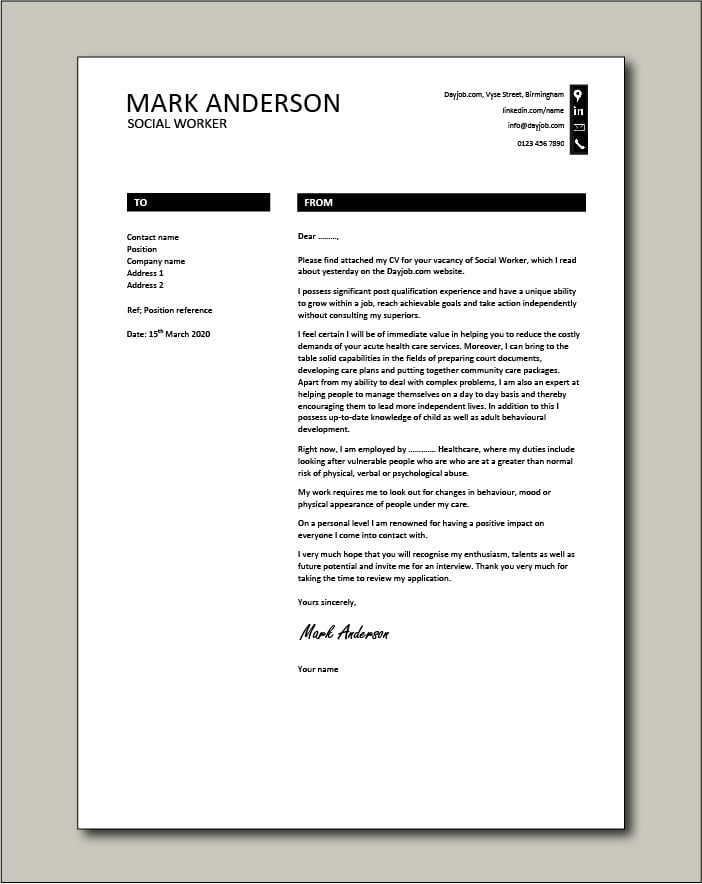
When writing a cover letter for any social worker related role reinforce your relevant skills and show the hiring team the expertise you can bring to their organization.

Immediately capture the reader’s attention by introducing yourself to employers by showing you can clean up homes, office buildings, shops, streets and other places.
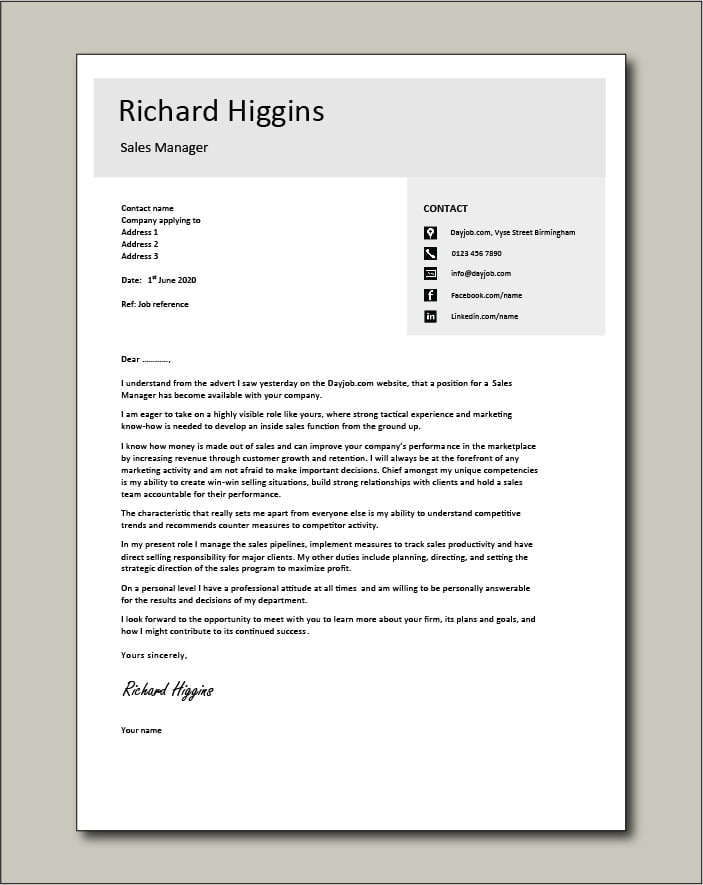
Set a positive tone in your letter by asserting your ability to plan, direct and coordinate marketing campaigns that will deliver a product or service to the customer.

Use the examples and tips on this page to convey your ability to run a profitable hotel by not only supervising staff and managing budgets, but also meeting goals.
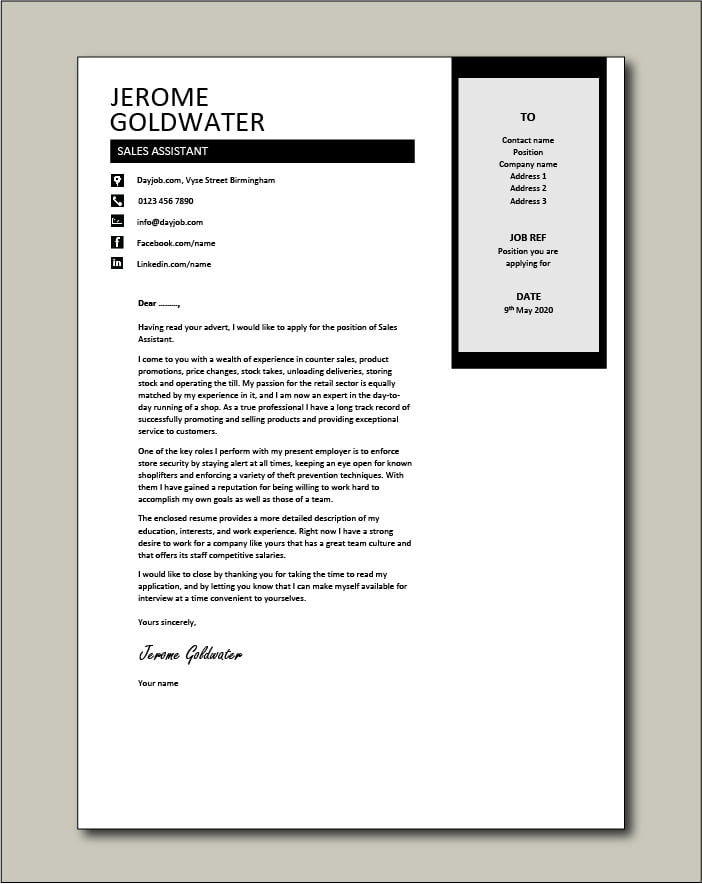
Having a good cover letter is a crucial step in getting invited to an interview. This page explains what to include in it and shares an expertly written example.
What is a cover letter?
This is a simple, concise and formal letter that you send with your CV when applying for a job. It can help your CV to get noticed, is vital in creating a good first impression and can be a key factor in getting you invited to a job interview.
Its aim is to build on the information you provide in your resume, and it must make sufficient impact on the reader to make them want to know more about you. It is a socially acceptable way of introducing yourself and explaining which vacancy you’re applying for or which area you are enquiring about.
It gives a personal touch to your job application which your CV cannot do, and is an ideal opportunity to match your skills and experience to those on the job specification. In essence a cover letter gives you the chance to express all those things that do not comfortably fit into a CV’s rigid structure. Therefore it should express a high level of interest and knowledge about the position, and be used to promote you as a person, your achievements and your personal qualities.
They are a good way to demonstrate your communication skills and thereby set yourself apart from other applicants.
Latest cover letter examples:
Workshop Controller cover letter example
Workshop Manager cover letter example
Tour Manager cover letter example
Deputy Care Home Manager cover letter example
Road Transport Manager cover letter example
Charity fundraiser cover letter example
Chauffeur cover letter example
Car Valeter cover letter example
Humanitarian aid worker cover letter example
Media researcher cover letter example
Immigration officer cover letter example
CNC machinist cover letter example
Stockbroker cover letter example
Bookseller cover letter example
Childminder cover letter example
Clinical psychologist cover letter example
Payroll administrator cover letter example
Train Driver cover letter example
Nutritionist cover letter example
Paediatrician cover letter example
Insurance Broker cover letter example
Interpreter cover letter example
Car Rental Agent cover letter example
Sales Ledger Clerk cover letter example
Anaesthetist cover letter example
Audiologist cover letter example
Collections Agent cover letter example
Purchase Ledger Clerk cover letter example
Customer Success Manager cover letter example
Logistics Clerk cover letter example
Office Clerk cover letter example
Estimator cover letter example
Freight Controller cover letter example
A cover letter is used to;
- Highlight information that is not given in your CV.
- Convince the employer of your enthusiasm.
- Explain special circumstances as to why you are suitable for the role.
- Give details of when you are available for interview.
- Reaffirm your Unique Selling Point.
- Explain any anomalies, like career gaps in your CV and application.
- Tell an employer when you are available to start work.
- Compliment a potential employer on their brand or reputation.
- Perhaps they have launched a new product or service that has greatly impressed you.
With all of these points in mind, we have listed below tips that you should follow if you want to increase your chances of receiving more interview invitations.
Need a cover letter?
If so then you’ve come to the right place. On this page you will find a list of cover letter examples that are free for jobseekers to download, print and use to write their very own professional one. You are advised not to simply copy these examples word for word, but to instead use them to gain ideas and inspiration from. The wording in these examples should be modified so that it fits your very own personal circumstances, and is targeted at the job you are applying for.
Cover Letter Layout
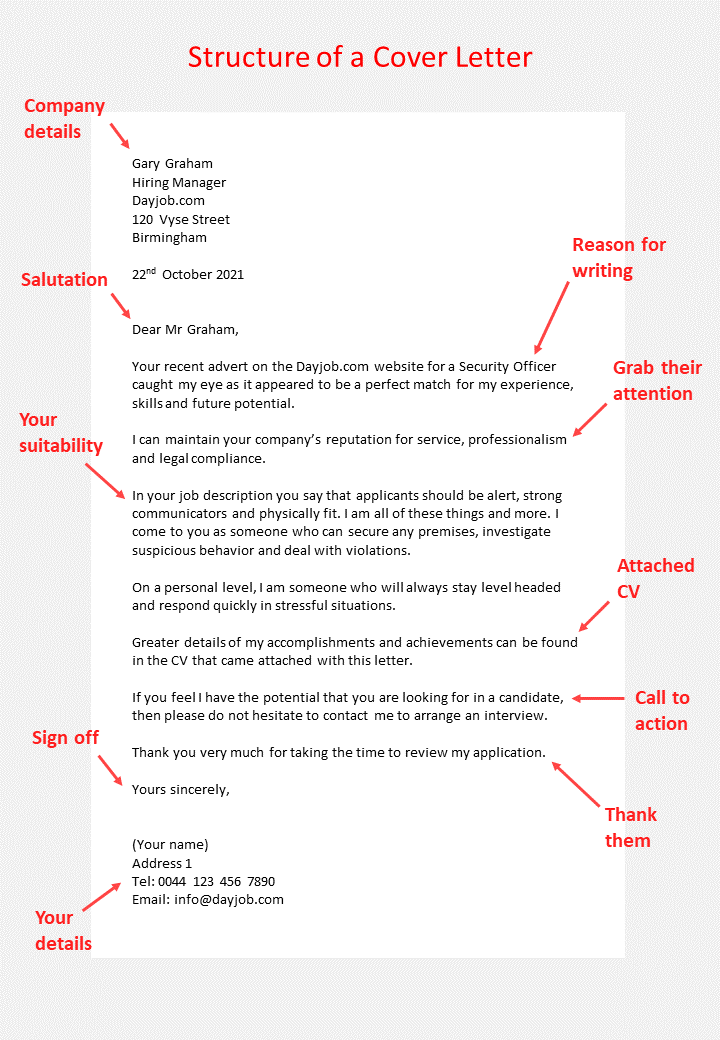
How to write a cover letter
The opening paragraph
This should be positive, formal, short and attention grabbing, clearly explaining why you are writing to them and informing them that your CV is attached. Try to avoid the same old tired opening lines, and instead go for something that grabs the reader’s attention. Effective ways to do this include name dropping, connecting to a common experience, or revealing some in-depth knowledge about the company. To summarise, key points to mention in the first paragraph are;
- The position you are applying for.
- Where you saw it advertised, or how you came to find out about it.
- Your present job title.
Here are examples of some conservative opening sentences you could use;
‘I read with interest of your organisation’s plan to (…….)’.
‘I would like to be considered for the position of (……….)’.
‘I was very interested to read your advertisement for (………)’.
‘Further to your advertisement in (……..), I should like to apply for (………).’
‘With reference to your vacancy for a (………).‘
‘Please find enclosed my application for the vacancy of (……….).‘
‘I am writing to you regarding the (………..) placement that was recently advertised, and would be most grateful if you would consider my application for this position’.
The second paragraph
This will form the main part of your letter and it’s the bit where you can really sell yourself. Focus on showing a recruiter how much they can benefit from your contributions to their company, and also mention how you relate to the companies values and aspirations. Explain what you can offer them, try to make sure that it is not just a list of what is in your CV but is individualised to the job application. A good way to complete this section is take the essential criteria from the personal specification given with the job advert, and then explaining how you full fill each one. Respond directly to the job advert / description by illustrating how your skills and abilities match what the employer wants. Concentrate on;
- Briefly describe your professional and academic qualifications that are relevant to the position.
- Key skills and experiences.
- If you’ve just graduated, focus more on the level of education you’ve achieved and your future potential as a productive employee.
- If you are changing careers then focus on your transferable skills.
- How it fits in with your career plans, for example if you are applying for Sales positions do not say that you want to to become an airline pilot.
The third paragraph
In this section specifically indicate why you are interested in the position by telling them what you are impressed with and what attracts you to them. When explaining why you want to work for them, here are some possible reasons you could give;
- The company’s reputation and brand.
- How the company is different from its competitors.
- List values that the company has and which you hold in high regard.
- How they are a exciting and forward thinking company.
- Detail how you see your career progressing if you were to get this role.
- Subtly flatter the company, for example ‘you are the industry leader’.
The end / Conclusion
Always end your cover letter on a high note. Conclude it by thanking them for their time and stating your anticipation of their response. At the end you should also request action, like asking for a interview or inviting them to contact you. If you are really keen on the position, then consider adding a line saying that you’ll give them a call to see how your application is progressing. Other points to mention include;
- Giving details of certain dates you are available for a interview.
- When you are available for work.
- That you are happy to provide any further information they need.
- Indicate your desire for a personal interview and that you’re able to meet with the employer are their convenience.
Avoid finishing it off with the usual ‘I look forward to hearing from you’, instead opt for something like;
‘I look forward to discussing my candidacy and the position with you further.’
At this stage and by the time you have finished your letter you will probably discover that you’ve written a great deal more than can fit onto the page, meaning you will have to refine and reduce the words you’ve written. It’s at this juncture that you have to start proof reading and revising your work, with a view to cutting out any unnecessary sentences.
Signing off a cover letter
Remember to sign it off, this may seem old fashioned in this digital age but it’s still a strong signal of your authenticity. If you address a letter to a specific person then you should sign it off as ‘Yours sincerely’. Whereas letters addressed to ‘Sir / Madam’ should be signed off as ‘Yours Faithfully’. Add a few blank lines and finish with your name. The space between is used for your signature once printed.
Addressing a cover letter
Always try to address the letter to a specific person, preferably the decision maker, hiring manager or individual who has advertised the job. The last thing you want is for your letter to go to the wrong person (in which case it will probably be binned as no one likes receiving unsolicited mail), or to simply get lost within a company’s Human Resources department.
Remember that if no-one’s name is given, your letter and CV could end up in a large pile being vetted by a junior administrator or recruiter who may not have a full understanding of the job, the department, or the role, making them the worst people to assess your application. If you really want to make sure your application is received you should even consider sending two letters, one to the hiring manager and one to the administrator or recruiter.
- Addressing the letter to a specific person can make them feel special.
- You are more likely to receive a reply if you address your letter to a specific person.
- Avoid addressing the letter as simply ‘Dear Sir / Madam’ etc.
If you are applying for an advertised vacancy there is probably a contact name on that advert, and so address your letter to that person. If a name is provided than address the recipient by their surname and never their first name, for instance ‘Dear Mr Johnson’, and never something like ‘Dear Chris’. Addressing a letter in the correct way shows a professional attitude, and promotes you as someone who is more likely to be able to handle themselves properly if they need to represent the company on business.
Cover letter writing tips
What if the job advert does not have a contact name
In these cases it may be worthwhile calling the company or visiting the company’s website and seeing if you can either track down the name of a relevant recipient or the person in charge of recruitment.
Target your cover letter at the job
Customize the cover letter to suit the position and the company, and avoid using the scatter gun approach of sending the same letter to every job you apply for. It is always best to write individual letters for each application you make. Take time to think through what would be relevant to the recruiter. Instead of scattering lots of information in the hope that one piece would be relevant, highlight a few key relevant points. This may be time consuming and hard work, but your chances of success will be much greater.
Key points to mention in a cover letter
- How you can be contacted.
- The job you are applying for.
- Where you saw the job advertised and also the date.
- Mention how you relate to the companies values and aspirations (i.e. your ‘soft skills’).
- Compliment the company on its reputation and client focus etc.
- Mention any recent news stories about them.
Use industry related keywords
Focus on using terminology, action words, buzzwords and sound bites that are appropriate for the industry. These are a good way of showing you are up to speed with any current and relevant industry developments.
Refer to the job advert
A good technique when writing your letter is to keep the job advert in front of you so you can quickly refer to it. By doing this you can ensure that you stay on track and keep focused on what the employer wants from applicants.
Skills and abilities to mention
Read the job description looking for specific requirements mentioned in there, then use those actual terms mentioned in the advert to describe yourself. Here are some examples of competencies that you can mention;
- Team working
- Problem solving
- Leadership
Best font to use
Always remain conservative with the typeface you use. For instance it is advisable to use Times New Roman or Arial rather than say Comic Sans. Ideally the text size should be between 11 or 12 points. Always use Black ink, never any other colours like dark blue or grey.
Make your cover letter easy on the eyes
Your letter should be easy to scan and have a logical progression. Avoid bunched up text in long paragraphs which can frustrate a Hiring Manager who has to review hundreds of resumes and cover letters a week.
Research the employer
Research the firm you are applying to, and try to incorporate your findings in your covering letter. By doing this you can impress the recruiter with your initiative and enthusiasm. They will like the fact that you have taken your own time out to investigate what their company is all about, which can go a long way towards convincing them that you have a genuine interest in their organisation. You can research stories about them though the:
- Internet
- Local newspapers
- The companies own website
- Trade magazines
Your aim is to find out any current news about them, their products and also how they are placed amongst their competitors. You want to find out about their;
- Latest products and services (are they launching any new ones).
- Competitors.
- Expansion plans (are they opening new stores or offices etc).
Research the industry and job role
This is separate from researching the employer, instead you will be looking at the industry as a whole, as well as the vacancy itself. Try to find any new developments in the sector, i.e. a major competitor has gone into liquidation, or any new products launched etc. Again this sort of research can impress prospective employers.
Stick to the facts
Recruitment staff are only interested in hardcore facts and not fluff. A cover letter is not an autobiography, stick to relevant facts, and remember that any additional information is superfluous and can be counterproductive.
Don’t repeat worn platitudes and clichés
Experienced recruitment staff regularly see candidate promises like ‘excellent written and verbal communication skills’, ‘ability to think outside the box’ and “juggle multiple tasks”. Avoid these and instead try to be original and different.
Explaining why the job appeals to you
It is best to focus on no more than one or two main aspects as to why the job appeals to you. Here is a example of what to write;
‘I am looking to pursue a career in journalism and was greatly impressed to discover that your vacancy has ……’.
Your contact details
Make it easy for the employer to contact you. Give them as much information as you can, including your;
- Name
- Home address
- Home telephone number
- Mobile number
- Email address
Cover letter length
As a rule it should be no longer than one page.
Date
You should use long date format in full i.e. 12th January 2012 and not 12/01/12.
How to make key information STAND OUT
Highlight important facts by making the text ‘bold’ or Italic and by using bullet points to draw attention to your most important messages. Use these sparingly to emphasize keywords that you want to be noticed, it is generally not a good idea to underline words.
Name dropping in a cover letter
This is a excellent way of quickly getting noticed. For instance mention if you went to a top university, have experience of working for one of the leading or most successful companies in the industry, or have worked on any well known cutting-edge projects.
Past achievements
Companies are keen to hear how you may have made a positive difference with a previous employer. You made have increased sales in your department by 100% over a short period, or you may have saved your company thousands of pounds by finding a cheaper supplier. Don’t be shy about presenting facts that will make you stand out.
Avoid being negative
A cover letter is not the place to explain why you left or are leaving an employer. Any negatives are best delivered in person so that your communication skills, personality and humanity can help to counter them.
Should you send it by email or by post?
Read the job advert carefully to make sure you haven’t missed any instructions on how to submit your covering letter and CV. If there is no preference requested then it really up to you if you want to send it as an email or through the post.
- If sending it in the post then paper clip your covering letter to the CV.
The envelope
If you are sending your application by post then make sure that the recipient’s name, department and address details on the envelope are the same as at the top of your cover letter.
What paper to use
You should only use good quality plain white paper. Do not use coloured paper, lined paper or paper with holes in it.
Sending your cover letter as an email attachment
Use sensible filenames for your attachments i.e. do not use something like ‘miketheman_coverletter.doc’, also use a subject line that will make sense to the recipient and looks professional, for example use the job name or reference i.e. ‘Office Manager Ref B234’.
Grammar and spelling mistakes
Make sure that there are none. Remember if there are any mistakes then your application is likely to be rejected immediately, recruiters will be reviewing your attention to detail and your ability to communicate in writing. Consider having a friend or colleague proof read your application.
Do not
- Use abbreviations
- Write more than four paragraphs.
- Ramble on.
- Repeat what you have already listed in your CV.
- Write it informally as this can be seen as being unprofessional.
- Boast or appear arrogant.
- Use flowery language.
- Submit a handwritten letter, it should always be typed.
- Mention what salary you expect to receive.
More tips on writing a cover letter
- Find a quiet place to sit down and start writing.
- Try to make it as personal as possible.