

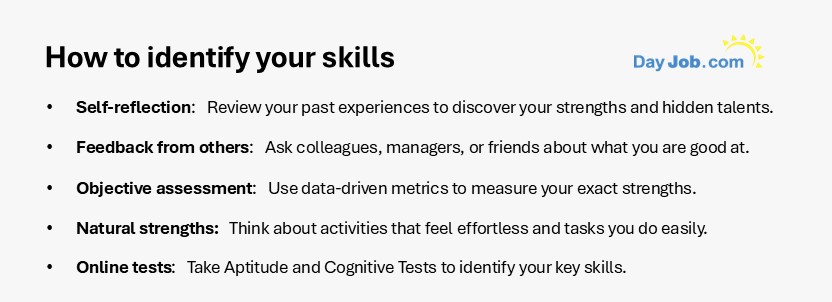
You can identify your skills through a combination of self-reflection, feedback from others, and an objective assessment of your past work experience. Scan your career history, previous roles, hobbies, and volunteer work to pinpoint those hard and soft skills you need to advance your employment prospects. Additionally, to dive in further into your competencies, you can also ask yourself what your interests are and what you like to do.
One you have all this information then break these down even further to identify the action verbs associated with skills that could make you a better candidate for a job. Finally, rate yourself honestly on each skill you’ve listed, using a scale from 1 to 5, with 1 being a beginner and 5 being an expert. By doing all of these steps, you’ll get a good idea do your strengths and weaknesses.
Read on to get a comprehensive guide on how to accurately identify your best skills.
By: Iejaz Uddin – Updated 9 August 2026
Page overview
- Why identifying your skills is important
- Understand the Different Types of Skills
- Identifying your hard skills
- Identifying your soft skills
- Recognize Your Natural Strengths
- Reflect on Your Experiences
- Ask Others for Feedback
- Document Your Skills
- Match Your Skills to Your Goals
Why identifying your skills is important
Skills can help you to find work and stay in work. They can give you confidence when job searching, which will translate into heightened self-esteem and reduced anxiety during interviews. In addition to this they can help you with career planning, by ensuring you set realistic career goals and pursue opportunities that align with your abilities and interests.
During this identification process you will not only identify the tasks you perform well but also areas for improvement which need to be addressed. These can be addressed through training, gaining new work experiences and developing additional competencies. Remember that this is not a one-time exercise but an ongoing process of self-discovery and development.
Understand the Different Types of Skills
Skills can be grouped into different categories, such as hard, soft, Cognitive, Adaptive and Personal. Each of these reflects a different aspect of a job seeker’s capabilities, and can be broken down even further into role specific ones such as leadership, management and communication etc.
It’s also worth noting that there is a difference between skills and experience. Although interchangeable they are not the same. A skill is classified as an ability that enables you to perform a particular task. Whereas, experience, on the other hand, is the practical application of your skills over a length of time.
Hard skills
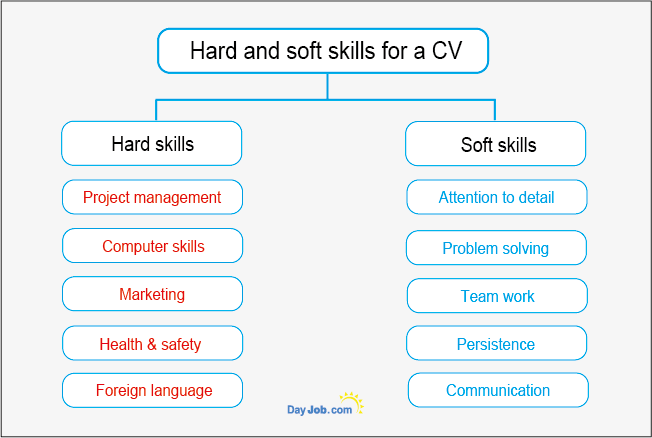
These are teachable and measurable tasks required to perform a specific job, task or solve a problem at a high level of proficiency. They are typically learned through formal education, training, on the job experience or certifications. Can also be gained through hand-on participation in real-world situations related to the skill or skill set.
Examples of hard skills:
- Project management
- Marketing
- Data Analysis
Soft skills
Also known as interpersonal and people skills, these are universal attributes that dictate how you interact with others and navigate challenges.
Often referred to as employability skills, they are general abilities people have developed across different paid or unpaid jobs and industries. They are generic and transferable abilities that you can carry with you from one job or industry.
The following are examples of soft skills.
- Communication
- teamwork
- Problem-solving
- Emotional intelligence
- Mechanical aptitude
Cognitive skills
These are mental and intellectual abilities used to think, read, learn, remember, reason, and pay attention. They allow a jobseeker to allow you to learn, process information, and solve complex problems. Unlike hard skills they are more centred around memory, attention span and thinking logically.
Identifying your hard skills
Pinpoint your hard skills by auditing your previous roles job descriptions, reviewing your daily duties and the tools you use at work. Objectively look at the technical tasks you are required to perform and then write down what you’ve done that’s been successful.
Study your past positions, performance reviews, and appraisals to identify industry specific hard skills. You could also take skills assessment tests or quizzes related to your field or areas of interest.
Identifying your soft skills
Find these by self-reflecting on your past actions and daily habits to highlight the transferable skills you possess and which recruiters’ wants. You could also ask people you like, or friends that you trust and respect what they think you’re best at. Also ask current or former supervisors, mentors, or work colleagues for input on where they feel you excel.
Also, carry out a STAR analysis by thinking about high-pressure situations you’ve dealt with, projects you led, or problems you solved. How did you break these down using Situation, Task, Action, and Result formula.
Your aim in all of this is to look for patterns in any transferable skills or employability skills that come up in these conversations.
Recognize Your Natural Strengths
Try to identify those tasks that energize you and feel effortless. You can do this by conducting an Energy Audit of yourself whereby you track your daily tasks over a week to identify what people ask for your help with.
Make a note of what friends, family, or colleagues consistently ask you to assist them with. Also analyse compliments you receive, as well as any feedback, evaluations, or casual comments you’ve heard.
Look for tasks which make time fly. You need to assess what comes naturally to you, as well as think about what motivates you to do things. It’s though this self-analysis that you can identify your natural strengths. If you are motivated to do certain tasks, then this is a clue as to what you’re good at.
Another option is to do an online personality profile test.
Reflect on Your Experiences
Start by writing down the tasks and duties associated with each job, ask yourself what you did, what you achieved and how you did it. Do not just simply recount what happened, instead ask yourself what you learnt by doing those tasks and what skills did you use.
Look at the past challenges you’ve faced and evaluate how you overcame these. What did you do that worked and what didn’t.
Another way to identify your skills is to use a Skills Audit test. This is where you list of the top ten skills valued by recruiters and then rate yourself against these through a scale of 1 to 10. You also have to provide evidence of these skills.
Ask Others for Feedback
Make a list of trusted friends, former managers, or family members and ask them what they think you are good at. Get feedback from multiple sources, including supervisors, peers, and subordinates. Don’t ask generic questions like “how am I doing?”, instead ask direct ones like ‘What do you think I’m good at?’. Ask these questions well in advance so they have time to answer thoughtfully with accurate high-quality responses.
Document Your Skills
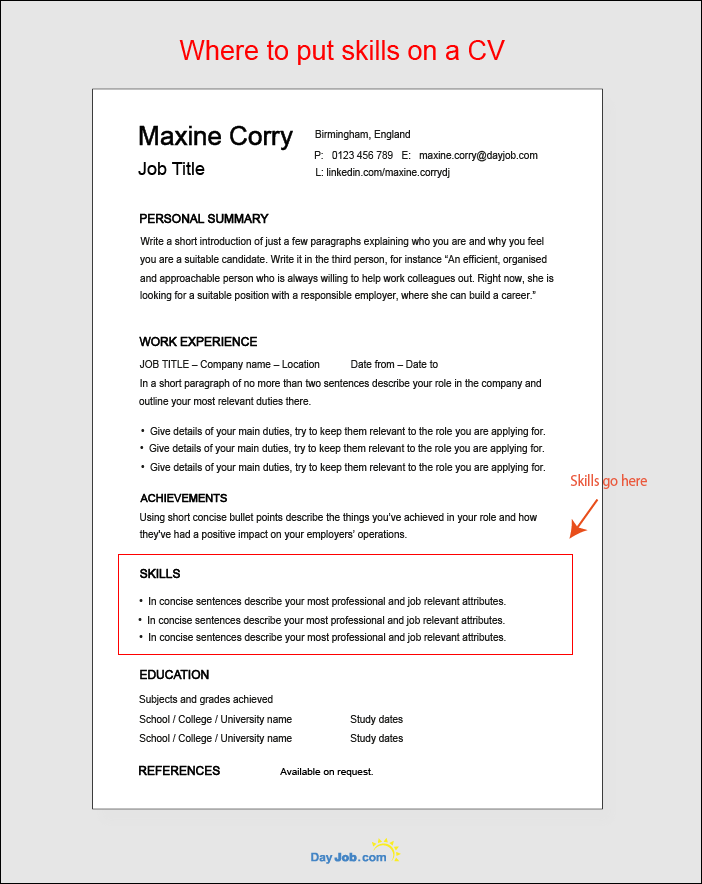
Once you have all of your skills, you now have to organise them, thereby creating clear documented evidence of what you can do.
Do this through a master document skills list or digital folder which can serve as a living record of your expertise, certifications, and achievements. It should not just be a static list, but one that is constantly updated with your “wins”, positive feedback, client testimonials, and performance reviews. These groups should be categorised into specific categories so recruiters can scan them at a glance.
Identifying skills you don’t have
When reviewing your skills, you can also look for skills you don’t have and identify areas where you’re not so strong. Take the opportunity to consider your strengths and weaknesses, find out what do you do well, and what do you struggle with. This can only be done through honest self-assessments, to spot blind spots in your capabilities.
Aim to make a list of the ones you don’t have, and in this prioritise those that need to be obtained first. Rank the gaps based on their importance to your career goals. Once you’ve identified the gaps in your skill set, you can then create a plan to address them through courses, workshops, seminars, mentorship, internships or good old fashioned work experience.
Match Your Skills to Your Goals
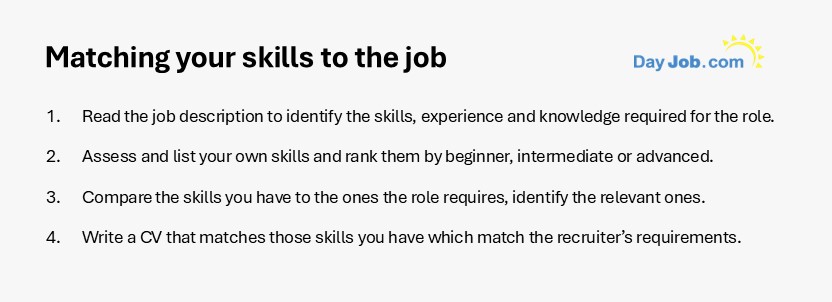
First define your goals or the job you want. Secondly, from the job description list the skills, experience and knowledge required for the role. Thirdly, assess your current skill sets and rank them by through beginner, intermediate or advanced. Finally, compare the skills you have to your goal or roles requirements.
Through this process you can identify which of your skills match the requirements and where there are gaps.
Identifying required skills
Review at the job advert and read it carefully, look for keywords that describe the skills and capabilities that a employer is expecting from an applicant. Break down a routine responsibility to see the action verbs associated with a specific task. Research the industry as a whole to analyse the objectives, roles and tasks and identify the criteria for a successful candidate.
Skills to put in a CV
Adaptable
Adaptable skills to include in a CV
Decision making
Decision making skills to include in a CV
Delegating
Delegating skills to include in a CV
Determination
How to show you are a determined person in a CV
Efficiency
How to show your efficiency at work
Focused
How to show you are a focused person in a CV
Hard worker
Hard working examples to include in a CV
Initiative
Initiative skills to include in a CV
Leadership
Leadership skills to include in a CV
Positivity
How to show you are a positive person in a CV
Problem solving
Problem solving skills to include in a CV
Professional
Professionalism skills to include in a CV
Sociable
Sociable skills to include in a CV
Team player
Team player skills to include in a CV
Related links